GV Gold CEO Sergei Gostev: Gold attracts everyone like a magnet, but the industry must be understood


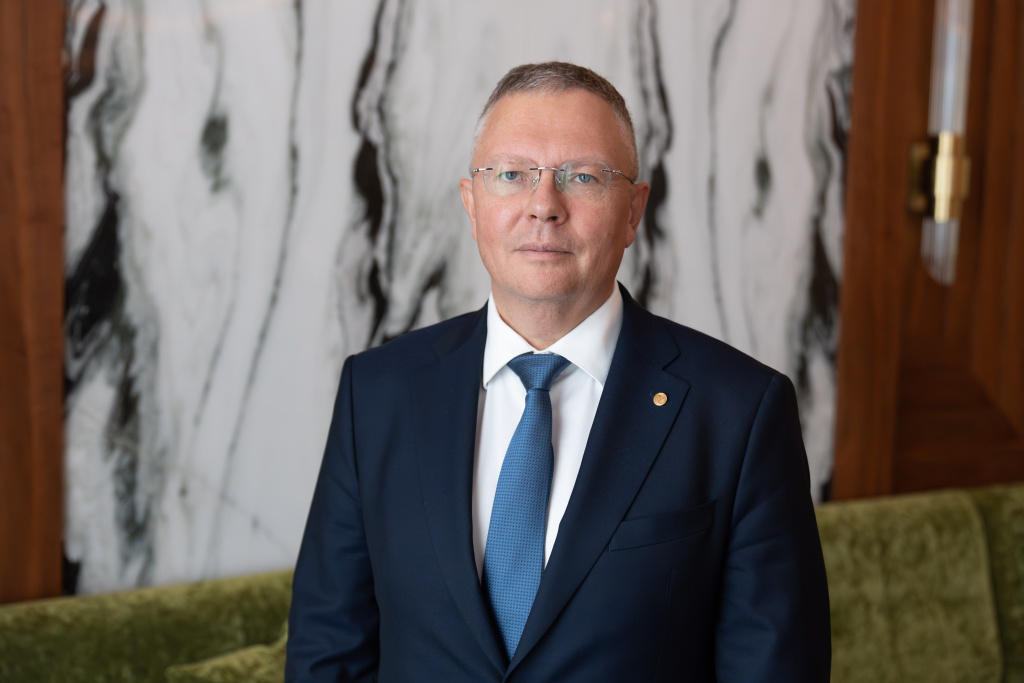
Sergei Gostev
Photo: Press-office
Gold miner GV Gold launched the Svetlovsky mine in the Irkutsk region last year. In an interview with Interfax, GV Gold CEO Sergei Gostev spoke of which goals the company now sets itself, which obstacles it is facing and its view on the prospect of attracting new investors. He also talked about the risks awaiting newcomers to the gold mining industry.
Areas for growth
Q.: Let's start from last year. What was the production trend?
A.: Last year, we reached roughly the same level of 2024 with 7.5 tonnes of gold. Over the past three years, while the Svetlovsky mine was being built, we kept up a consistent pace. Svetlovsky will help us to grow this year.
Q.: What is the plan for this year and how much do you estimate Svetlovsky will contribute?
A.: Our ballpark figure is 10 tonnes. The Svetlovsky mine will make up around 30%-35% of this. That is, we expect to have substantial growth, and we will achieve this thanks to Svetlovsky.
Q.: And is Svetlovsky already working at full capacity?
A.: We have ramped it up to the specified indicators and are now working to confirm their stability. Since Svetlovsky was launched, over 2 tonnes of gold has been produced.
Q.: GV Gold also has a practice of increasing the productivity of existing capacities without making any substantial changes to their construction. Could it be possible to scale up in this way at Svetlovsky?
A.: There is a possibility, and we planned for that. What we now need is stable results, and after that we will move on to growing the productivity of the plant. We are looking into which production divisions can be expanded without significant investments. This always comes down to not only the gold recovery plant, but also the mining and transportation complex and the adequacy of reserves. We don't see any constraints here - this is simply our next step. We are now in the process of stabilizing, and then we will start speeding up the plant taking into account the other divisions.
Q.: Now that you have consolidated the Krasny project in the Irkutsk region, what is going on there? When can we expect an investment decision?
A.: Krasny is our next development project. We now need to do the preparatory work: list the reserves on the government balance sheet, conduct the pre-FEED. Our task for the present moment is to reach a stable 10 tonnes without Krasny, and then after that we will make a decision on investment and move into the active phase.
Q.: What would be a realistic launch date and scale?
A.: Based on our construction experience, around three years pass from the moment the decision is made to the launch of the plant. In terms of scale, we place Krasny among our largest deposits, and it is the most explored site in our portfolio. We can safely say that there will be 100 tonnes of gold plus there. We also see how other similar deposits are developing in the Bodaibo district of the Irkutsk region. The plant will have similar volumes to Svetlovsky, which processes 3.5 million tonnes of ore per year, to possibly be increased later on. As such, the volume of investments will also be comparable, taking into account inflation.
At the same time, Krasny is more advantageous in terms of infrastructure costs. At Svetlovsky, a lot was invested in logistics, the road and energy. Krasny is closer to the road. I can't say that these costs will be entirely non-existent, but the location of the deposit is more advantageous than the others. As such, we expect to have lower investments in infrastructure and simpler technical solutions.
Q.: And is the Maltan project in Yakutia still a source of feedstock for Taryn (the Drazhnoye deposit) or will that be separate?
A.: We are conducting active exploration work on various sites at Maltan. We will make a decision once the exploration is complete. Currently, this is seen as an additional resource base for Drazhnoye, but we will base our decision on the results of geological exploration.
Q.: Is there a possibility that the Maltan and Krasny projects will be implemented in parallel?
A.: We will most likely start with Krasny. We have enough reserves at Drazhnoye to load capacity in the current mode without having to rush with a new project. Also, Yakutia is a more complex region logistically speaking. And we understand that we are working with the same refractory ores at Maltan as at Drazhnoye: the concentrate needs to be transported elsewhere, and that is, again, logistics. Plus, energy security places restrictions on the development of remote sites - I am referring to the cost of diesel fuel and its availability, the reliability of energy supply.
Q.: As a percentage, how much of your production does refractory ore currently account for?
A.: About 50/50 at Taryn.
Q.: And what are you doing with refractory ores at the moment?
A.: We export the concentrate to China.
Q.: I also wanted to ask about the Golets Vysochaishy asset. How many years from now will those reserves last?
A.: We have begun geological exploration at deeper levels, and this is proving to be promising. There was no necessity to go deeper before - there were enough near-surface reserves. But this is already a mature deposit. We have gone deeper and can see prospective ore bodies. We will make a decision once geological exploration is complete. The volume that has been explored so far gives us reason to say that the development period will be prolonged through a transition to underground mining. This will be our first underground mine.
On top of that, a significant number of tailing dumps have formed throughout operations at Golets Vysochaishy. These were previously considered unprofitable, but the current price of gold is making it economically viable to process them. Therefore, looking at our long-term plans, we can see that Golets Vysochaishy will definitely be functioning after 2030.
Q.: What is the gold content of the tailings?
A.: We are now completing geological exploration work, and I'm not inclined to comment on tailings specifically at the moment. I can say that it would be economically viable to process 0.25-0.3 g/tonne at the existing processing capacities. This is a low grade, but it is advantageous to process 0.3 g/tonne when there are already capacities and technology ready to use and the volumes of mining operations are not substantial.
Q.: What are the current areas for growth?
A.: We are working on expanding the resource base and on geological exploration, while remaining in the Bodaibo district. We currently have licenses for Botolo-Kharchikha, Ozherelye and Ykanskoye, which we view as additional resource bases for existing processing capacities.
We will definitely have growth at Krasny, and we will have various investment options to choose from for Maltan; and in the period between investments, we will most likely dedicate our attention to the Aldan alluvial gold deposit (Yakutia), which we also see as an area for growth.
Last year, the investment cycle was tied to our processing capacities, but over the next three years it will be tied to geological exploration. We are already investing significantly: our budget for geological exploration work has doubled year-on-year. We are gearing the geological service up for increased efficiency and quality growth, and placing a lot of emphasis on forming a geological exploration team - both at mines and centrally. This is our main focus now.
Q.: You mentioned alluvial gold. What percentage of production does it currently make up?
A.: A stable 5% - as a proportion of overall production, that is not much. But our target is indeed to bring the deposit up to 1 tonne.
Q.: What I wanted to ask was more whether you are considering divesting from this asset, on the contrary.
A.: Alluvial gold reserves are straightforward and substantial, and just require effective mining. Yes, the dredging method is less efficient than mining ores in an open pit, but it provides a profit and a stable cash flow.
Plus, we have begun mining alluvial gold at Taryn as well - we have taken up the Pravaya Terrasa site next to Taryn. We have three wash plants there, we understand how to develop this competency and we see its additional benefits. There is also a strong team of professionals both at Taryn and at Aldan. The best thing in this is people and technologies - they need to be reinforced. So, no, we are not planning to quit the alluvial deposits.
Regulatory issues
Q.: I get the impression that recently there has been increased pressure on placer mining from legislation and environmental authorities.
A.: We see this and understand that we need to conduct activities carefully, in accordance with the law. But attention from inspectors and government agencies has always been focused on us as a large company; for us it has not increased. Perhaps it has become the same for small subsoil users as well, and they have felt this pressure.
It's true that our legislation regarding subsoil use and the environment is strict. We fulfill all the necessary requirements, and like other mining companies, we expect the state to remove excessive administrative barriers. For example, relict forests cannot be destroyed, and we do not engage in that. But when there is deadwood that is classified as commercial forest, this needs to be approached objectively - forests should be reclassified into another category and the opportunity should be provided to conduct activities based on the license that will yield an increase in reserves.
Q.: It also seems that licenses have been revoked more often for violations of deadlines.
A.: It's clear that the state wants to bring order to this area. As subsoil users, we are also interested in ensuring that there is an increase in reserves under the obtained license. Holding a license without fulfilling license agreements is wrong. But different situations can arise, and it is important that the circumstances that led to deadlines being violated are examined objectively when taking inventories.
Costs and prices
Q.: What trends do you see with respect to costs?
A.: Here is the question. The fact that costs per ounce or per gram are increasing is neither good nor bad. The price of gold has given all of us the chance to process what was previously not processed. And an important component of cost is the average grade. Why does someone's cost per gram or per ounce increase? Because the depth of mining increases, and the level of overburden and capital mining works grows. The Mineral Extraction Tax (MET) also had an impact: in addition to the base rate of 6%, there is also a surcharge to the MET on gold - 10% of the excess of the world price over $1,900 per ounce; the rise in the price of gold affects the cost of marketable products.
Nevertheless, taking into account the rise in the gold price, we have revised the quality of raw materials that we are ready to process, and we have seen that for many deposits we can extend the production life - the life of mine (LOM). In some places, we can convert off-balance sheet reserves into balance sheet reserves; in others we can start processing dumps. It is true that the cost per gram will increase in this case, but we look at it comprehensively. For us, cost is not the only thing that matters. Why can we afford this increase? Because the price has risen. We maintain the margin that is necessary for the reproduction of the mineral resource base, the payback of investments and the payment of dividends to shareholders. That's all there is to it.
Q.: What about the inflation component?
A.: The inflation component has not been canceled either. And we cannot be compared with official inflation, as we have our own, highly specific consumer basket. It is linked to wages, energy and diesel fuel. Although diesel generation is mostly a backup for us, as at all deposits we are provided with electricity from the grid.
Q.: Why is the wage fund growing so sharply in the mining industry?
A.: Competition for people and a general catastrophic shortage of qualified personnel.
For rotational workers, everything is simple: they leave the rotation, find a higher salary elsewhere, and they are already moving forward. A person travels their whole life; for them, going to one enterprise is the same as going to another. Some then return when they evaluate not only the salary, but also the quality of life and the team. But before a person understands this, several rotations may occur.
Young specialists are now in great demand. For example, I look at geology students. There are people who are passionate about the profession and perfectly understand that geology does not just mean luxurious offices and romance and sunrises. It means hard work, when you need to go out into the field for an entire field season.
Young specialists' requirements from their employer are higher today than they were for my generation. My parents took part in Communist Youth construction projects, and I do not remember them being bothered by the living conditions; they built their own way of life. Today expectations are different, and we must fulfill a significant part of them. But a person must also be ready for certain conditions. For a geologist to start working with a document, he still has to go through this "romance of the open roads".
Q.: Is the company returning to plans for an IPO at the psychological level?
A.: We are facing investment decisions, and they are always capital-intensive. A choice arises. We built Svetlovsky during a period of high interest rates and understand that the cost of debt financing is still not at the level to provide investments with the necessary cheap and long-term resources. If we want to invest without increasing the company's debt, one way out is an IPO or attracting an investor. To do this, preparatory work is always carried out - audits, confirmations, independent studies. The company must be understandable to any investor. We are now paying attention to this. What this will lead to will be shown by the market; it will definitely lead to another investment project being implemented.
Q.: The peak of investments in Svetlovsky has passed. When is the next one?
A.: We are now in a debt reduction cycle. If things move to construction in two years, then either we will return to the existing level of debt, or we will attract investments. Private investment now looks more realistic. We looked at what IPOs other companies are conducting, and they do not raise the level of investment that we need. So this is a distant prospect. The capital market is volatile, and a long period of time will pass before everything settles down. Private investment therefore looks like a more predictable source for us.
Q.: Are you getting inquiries?
A.: In the industry, everyone is interested in each other, including foreign investors. We have a community in the Commonwealth of Independent States and China, and there are other investors. Each investor has its own cycle. They are interested, yes. And everyone needs profitable projects.
New people appear. Naturally, gold attracts everyone like a magnet. But the question, again, is understanding the industry. When everyone looks at a beautiful picture, they must understand that the investment cycle is not only about conducting exploration and building a plant. It is also a cycle of design and permitting documentation, and not everyone is ready for it, not everyone has infrastructure. Having obtained a license, many people think: "Now I will put reserves on the balance sheet in a year, and in three years I will have a plant." This understanding of the cycle is too rosy. Yes, you can build quickly - when you are in the industry, when licenses come one after another and you are working on different fronts.
One must also keep price volatility in mind. It can move both up and down. Some deposits become not very profitable at a certain point, and the banks' view of certain areas changes.
Q.: What price are you currently factoring into your budget?
A.: We were guided by $4,000 per ounce and an exchange rate of 75-80 rubles per dollar; that is, we factor in a ruble price of about 10,000 rubles per gram. It is currently within these figures - higher in some places and lower in others. We believe that from the point of view of annual budgeting, such a figure can be adhered to.
Forecasts are a thankless task, but we see both the summer and winter cycles of price changes. The price has made it possible to extend the production life for many assets. But this does not mean that we do not have a plan B. We simply have more options. The variability of models has increased many times over. We understand that when conditions change, we will either add projects to the portfolio, or put some projects on hold, or implement them somewhat later.
